Marketing Psychology

Marketing psychology for SaaS landing pages

A landing page is not a brochure. It is a decision environment. The visitor arrives with limited attention, partial trust, and a quiet question: should I spend more time here? Marketing psychology improves conversion when the page answers that question faster, with less ambiguity and less perceived risk. The goal is not manipulation. The goal is clarity, credibility, and momentum.

This guide focuses on SaaS landing pages because they often fail in the same predictable ways: the headline is broad, the body copy describes rather than persuades, proof is thin, FAQ is generic, and the call to action asks for too much confidence too early. If your product page already has a stable layout and visual identity, you usually do not need a redesign first. You need a sharper message architecture. That is exactly how we approached the uni-1 homepage and how the same framework can be applied to your pricing page or comparison content.

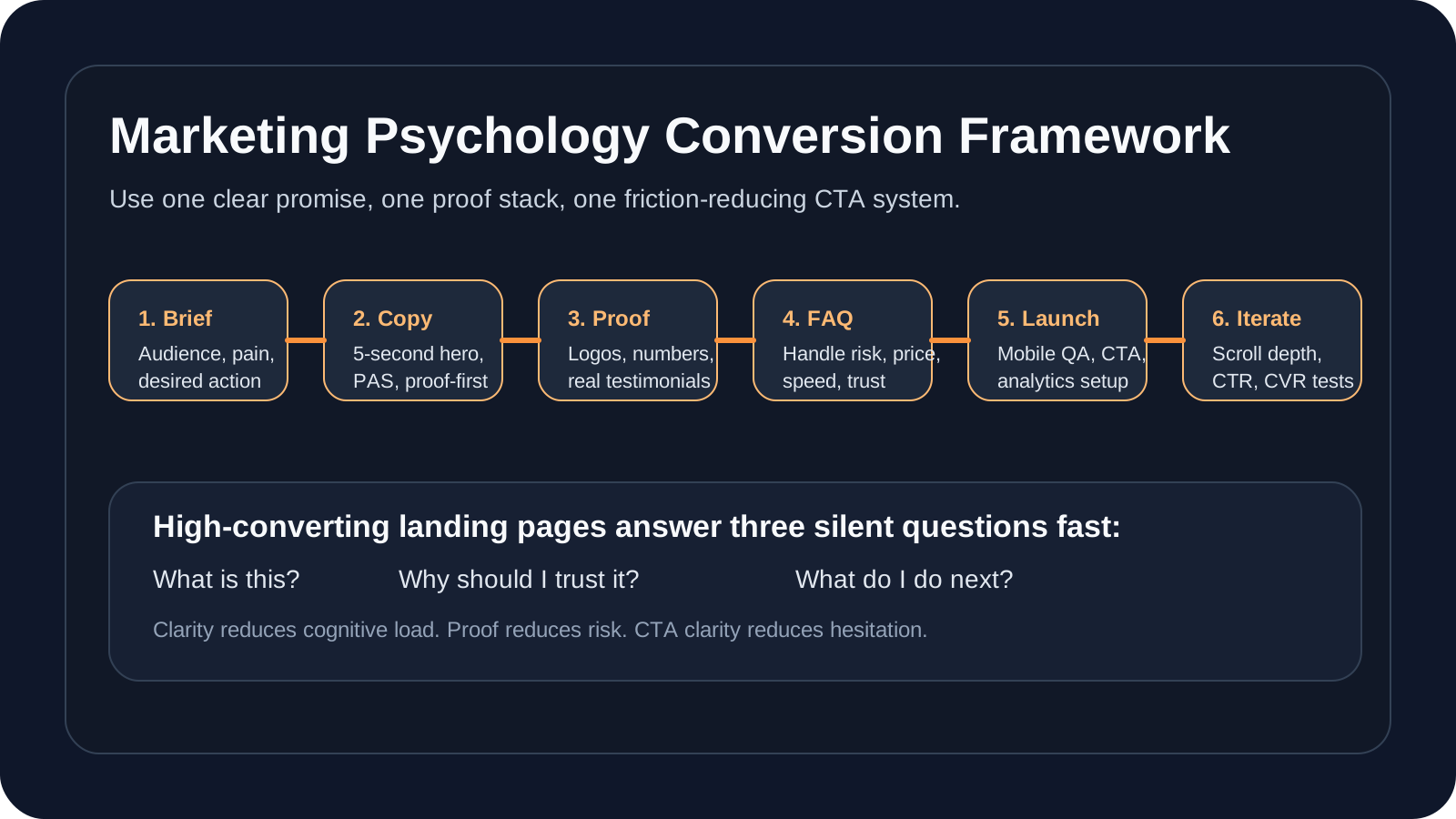
Marketing psychology conversion framework showing brief, copy, proof, FAQ, launch, and iteration for SaaS landing pages

What high-converting SaaS landing pages do in the first five seconds

The first five seconds determine whether the visitor keeps reading or starts mentally backing away. At that moment, design matters, but comprehension matters more. A strong landing page immediately tells the reader what the product is, who it helps, and what changes if they keep going. That is why short, specific headlines beat clever ambiguity so often. Clever copy delays understanding. Clear copy accelerates it.

The same principle applies to every supporting block. Social proof should not require interpretation. Feature sections should not force the reader to translate jargon into business value. CTA text should not create uncertainty about the next step. Marketing psychology at this stage is mostly about reducing cognitive load. Visitors should never have to work hard to understand why the page deserves their attention.

Start with the brief, not with decoration

A conversion page begins with forced clarity. Name the product, the audience, the pain, the desired action, the strongest differentiator, the highest-friction objection, the proof you can actually show, and the exact promise the page is allowed to make. If any of those fields are blank, the page will drift into generic adjectives. Marketing psychology works because it aligns message with motive. It fails when copy tries to look polished before it becomes specific.

Run the five-second test on the hero

The hero has one job: answer what this is, who it is for, and why it is worth attention before the visitor starts scrolling. That means the H1 should describe the core outcome, the subheading should translate mechanism into plain language, and the primary CTA should sound like the next logical step instead of a vague invitation. Visitors decide quickly whether a page feels expensive in time, confusing, or risky. The hero should lower all three costs.

Agitate the problem without sounding theatrical

Problem sections convert when they mirror the buyer’s current frustration. Use PAS logic carefully: state the problem in concrete terms, show the operational cost of leaving it unsolved, then position the product as relief. Good agitation names delays, wasted spend, rework, handoff chaos, approval loops, and missed opportunities. Weak agitation talks about “unlocking growth” without naming the bottleneck. Buyers trust pages that sound like lived experience, not slogan factories.

Stack proof in layers

One testimonial is not a proof system. High-converting SaaS pages usually combine at least three layers: recognizable logos, measurable numbers, and human quotes with enough context to feel real. This works because different visitors look for different trust anchors. Executives scan for logos and metrics. Operators look for use-case specificity. Skeptical buyers want to know whether a team like theirs already survived implementation. Proof should feel cumulative, not decorative.

Use FAQ to kill hesitation near the CTA

FAQ is not filler. On a commercial landing page, FAQ should handle the exact questions that prevent the click: price risk, onboarding speed, implementation burden, refund logic, data safety, output quality, and fit for a specific workflow. Good FAQ answers do not ramble. They remove uncertainty, set the next expectation, and keep the buyer moving. This is the last place where many pages can win back users who are almost convinced but still nervous.

Launch with measurement, then iterate

Marketing psychology is only useful if it changes behavior. After launch, watch conversion rate, scroll depth, CTA click-through rate, bounce behavior on mobile, and where users stop interacting. Then iterate one block at a time. Rewrite the hero before redesigning the whole page. Tighten proof before adding more sections. Compress vague copy before inventing new claims. The fastest lift usually comes from stronger clarity and stronger trust, not from more visual complexity.

How to rewrite each section without changing the UI

The most practical way to use marketing psychology is block by block. Instead of redesigning the whole page, rewrite the message inside the existing structure. Preserve the interface, preserve the visual language, and raise the clarity of each section. That approach is faster, easier to QA, and easier to measure because you can isolate what actually improved conversion.

Hero

Lead with the outcome buyers care about, then explain the mechanism in one sentence. Avoid broad claims like “reimagine your workflow.” Prefer language that states the result, such as faster approvals, fewer revisions, or clearer output control. A strong hero also uses a CTA that sounds low-friction: “Audit My Landing Page,” “Start a Free Trial,” or “See Pricing.”

Problem Section

Name operational pain the visitor already feels. Examples: unclear positioning, weak proof, generic headings, too many CTA choices, or an FAQ that does not answer purchase objections. The goal is recognition. When the page reflects the buyer’s problem accurately, the product feels more credible before you even explain the solution.

Solution Section

Translate features into decision relief. Instead of saying “advanced controls,” explain what control removes: extra back-and-forth, higher creative drift, or inconsistent outputs. Solution sections work when each claim connects a product capability to a practical win the visitor can imagine using next week.

Proof Section

Proof should show evidence from multiple angles. Include concrete adoption signals, quality signals, and user language. If you use testimonials, add role context. If you use numbers, explain what they refer to. If you use customer logos, place them near a metric or quote so the block reads as trust, not wallpaper.

FAQ Section

Treat FAQ as objection handling, not content padding. Each question should be phrased in the language a real buyer would search or say out loud. Each answer should be short, direct, and specific enough to lower risk. Keep answers grounded in what the product actually supports today.

CTA Section

A good CTA section combines motivation and reassurance. Remind the visitor what they gain by clicking, then remove one last friction point with a brief note about trial availability, setup speed, or pricing transparency. The CTA should feel like progress, not commitment pressure.

If you want a quick operational rule, remove descriptive copy and replace it with decision copy. Descriptive copy explains what the product is in broad terms. Decision copy explains why the buyer should move now, what risk is lower because of this product, and what the next step will feel like. That is the difference between “our platform is powerful and flexible” and “review headlines, proof, FAQ, and CTA friction before you send more paid traffic.”

This distinction also improves SEO when done correctly. Search intent is usually practical. A visitor searching for marketing psychology for SaaS landing pages wants applicable frameworks, not philosophical commentary. When the content reflects that intent through clear H2 and H3 structure, the page becomes easier for both users and search engines to interpret. That is why semantic headings, concise paragraphs, and one clear keyword group matter so much on conversion-oriented pages.
Recommended FAQ structure for a SaaS landing page

FAQ performs best when it removes the last practical objections a buyer has before clicking. It should not repeat feature copy or generic help-center language. It should respond to real doubts: how fast can I get value, what does this cost, is the output reliable, what happens if it does not fit my workflow, and can I trust the claims on this page?

How fast can I tell whether this landing page is underperforming?

You can usually diagnose the biggest copy issues in one pass. Look for a weak H1, a vague subheading, low-credibility proof, and FAQ items that dodge buying objections. Those four areas explain a large share of soft conversion pages.

Do I need a redesign to improve conversions?

Not usually. The first lift often comes from message clarity, proof hierarchy, and CTA friction reduction. If the structure already works, rewriting the page can improve performance without changing the overall layout or visual system.

What should I test first on a SaaS landing page?

Test the hero first. A clearer H1, a tighter subheading, and a more explicit CTA often change the rest of the funnel. After that, test proof density and FAQ quality before experimenting with cosmetic design changes.

What kind of proof raises conversions fastest?

Specific proof. Metrics tied to a meaningful outcome, customer quotes with context, and recognizable customer or partner names usually outperform generic claims about being powerful, simple, or innovative.

Where should FAQ live on a conversion page?

Place it after the main proof and before or beside the final CTA. That sequence works because the visitor sees value first, then gets the last objections resolved before deciding whether to click.

How do I keep SEO copy from hurting conversions?

Use one keyword group per page, keep headings readable, and write for user intent first. SEO copy should clarify relevance, not inflate the page with repetitive filler. Good conversion copy and good SEO copy can reinforce each other when the topic stays tight.

Notice the pattern: each answer lowers a distinct kind of risk. One lowers effort risk. Another lowers financial risk. Another lowers trust risk. When FAQ is written that way, it becomes part of the selling system rather than an appendix. That is why FAQ often belongs close to the final CTA on a SaaS landing page.

If your current page already has an FAQ block, do not ask whether it exists. Ask whether it resolves the objections that stop conversion. If the answer is no, rewrite it first. That is usually a better use of time than adding more decorative sections higher up the page.

A practical audit checklist before launch

Before you send more traffic to a SaaS landing page, run a short audit. Make sure the H1 can survive the five-second test. Make sure the subheading explains the mechanism without jargon. Make sure the primary CTA sounds like a next step, not a commitment trap. Make sure the proof stack includes recognizable signals. Make sure the FAQ answers purchase objections. Make sure the mobile version keeps the same narrative sequence. Make sure your analytics tell you where users hesitate. Then ship.

The deeper lesson is simple: landing pages win when they reduce uncertainty. They do not need louder adjectives, more animation, or more decorative complexity. They need clearer claims, sharper proof, better objection handling, and a CTA that matches the visitor’s confidence level. That is the operating system behind marketing psychology, and it works especially well when you apply it to an existing page instead of waiting for a total redesign.

Apply the framework next

If you want to see the framework applied in context, start with the uni-1 homepage, review the pricing page, and compare the message structure against your own landing pages. Keep the current layout, tighten the copy, strengthen the proof, and let the data tell you what changed.